
What if the difference between chronic neck pain and a pain-free life comes down to exactly 300 grams of breast tissue? Most insurance companies draw a rigid line at 500 grams per breast, assuming this arbitrary threshold resolves all functional complaints. Yet orthopedic biomechanical data reveals a far more disturbing reality: removing 500g versus 800g produces dramatically different outcomes for your spinal alignment, and the current insurance coverage criteria completely ignore the individual frame mechanics that dictate whether you heal or hurt.
This article presents the clinical evidence behind the breast reduction weight threshold and exposes why standard gram minimums fail patients with smaller torso frames. You will discover the measurable spinal loading differential between 500g and 800g removal, how the breast-to-torso ratio predicts postoperative posture improvement, and the exact consultation framework for building an evidence-based insurance appeal. Dr. Bora Yücel, SURGYTEAM’s FEBOPRAS-certified breast surgery specialist, integrates orthopedic assessment into every reduction plan—because your spine deserves better than a one-size-fits-all rule.
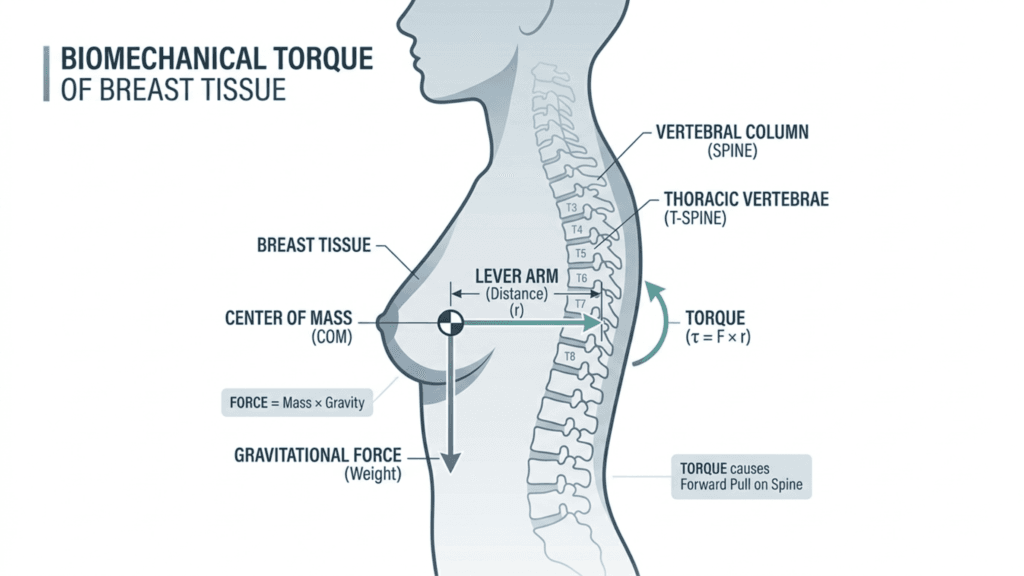
Table of Contents
The 500-Gram Myth: Why Insurance Coverage Criteria Miss the Spine
Insurance companies worldwide rely on the Schnur Sliding Scale, a 15-year-old algorithm that ties removal eligibility to body surface area. Under this model, a woman with a body surface area of 1.7 m² must lose at least 450–500g per breast to qualify for coverage. The system treats gram weight as a universal proxy for symptom severity. It does not. A 500g reduction on a narrow-framed patient weighing 55 kg places completely different mechanical demand on the thoracic spine than the same 500g on a broader-framed patient weighing 80 kg.
The breast reduction gram threshold fails because it measures mass without context. Think of it this way: carrying a 10 kg backpack affects a child far more than it affects a 90 kg athlete. Breast tissue operates under identical physics. When a payer demands 500g minimums, they assume every torso experiences identical load distribution. Biomechanical research contradicts this assumption directly.
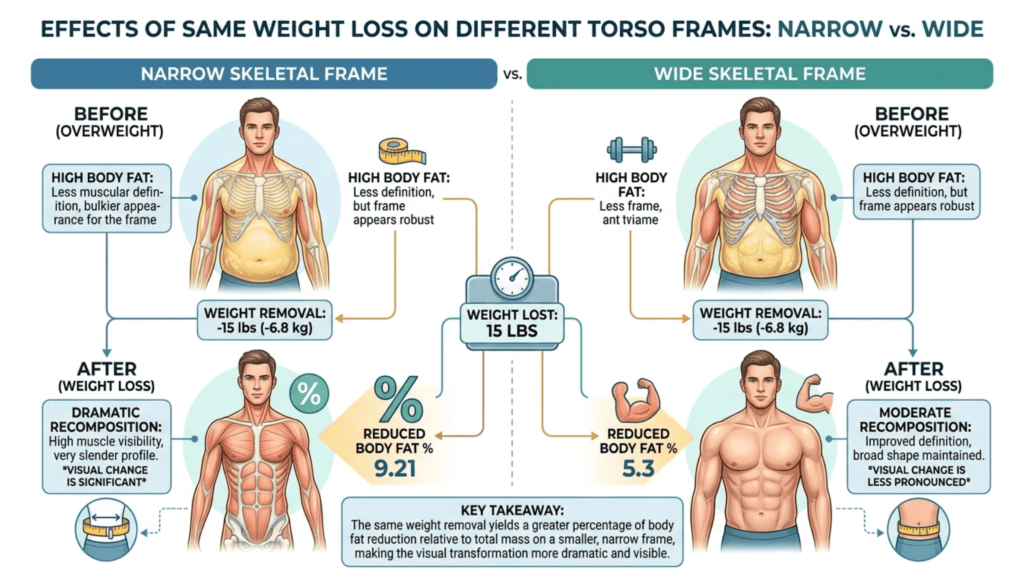
A 2021 study published in Plastic and Reconstructive Surgery demonstrated that patients with macromastia carry an anterior load that shifts the center of gravity forward by 3.2 to 5.8 cm. The body compensates by increasing lumbar lordosis and thoracic kyphosis. This compensation is not uniform—it scales inversely with torso width. Narrower frames experience greater angular displacement per gram of breast tissue than wider frames. Therefore, a woman who needs only 400g removed per side may experience equivalent spinal strain to someone who needs 700g, simply because her skeletal architecture concentrates the load along a narrower base.
Macromastia Biomechanics: How Breast Weight Loads the Spine
Understanding the biomechanics of macromastia requires grasping one fundamental concept: the moment arm. Breast tissue sits anterior to the spinal column, creating a lever that exerts torque on the cervical and thoracic vertebrae. The longer the lever—meaning the greater the projection of the breast from the chest wall—the more rotational force each gram generates. This is why two patients with identical breast weights can present with entirely different severity of spinal alignment after reduction outcomes.
Electromyographic studies reveal that women with macromastia show sustained hyperactivity in the upper trapezius, levator scapulae, and cervical paraspinal muscles throughout the day. These muscles fire continuously to counteract the anterior pull. Over months and years, this chronic co-contraction produces myofascial pain, trigger points, and eventual cervical disc degeneration. The neurological cascade does not reverse itself when a patient simply strengthens her core—no matter how many physical therapy sessions the insurer mandates before approving surgery.
The Force Equation Behind Symptomatic Macromastia
Biomechanists calculate the effective spinal load using the formula: Torque equals Mass multiplied by Distance from the vertebral axis. A 600g breast on a patient with a 22 cm sternal-to-nipple distance generates approximately 13.2 Newton-meters of torque. Increase that distance to 28 cm—a common measurement in grade 3 ptosis—and torque jumps to 16.8 Nm. That 28% increase in rotational force occurs at the same gram weight. Insurance scales measure only mass. They ignore the distance variable entirely, which explains why gram-based thresholds systematically underpredict symptom severity in patients with significant ptosis.
The 500g vs 800g Spinal Loading Differential: Hard Numbers
This section presents the most critical data in this entire article. When surgeons remove 500g versus 800g from a patient with moderate-to-severe macromastia, the downstream effects on the spine differ not by degrees but by categories. Removing 500g often eliminates the cosmetic excess while leaving enough residual anterior weight to maintain compensatory postures. Removing 800g, by contrast, frequently crosses the mechanical threshold necessary for the spine to re-center itself.
Patients seeking reduction mammoplasty deserve to understand these numbers before surgery. The data below comes from combined radiographic and force-plate analysis across multiple clinical studies tracking preoperative and postoperative posture in breast reduction patients.
Comparative Spinal Alignment After Reduction: 500g vs 800g Removal
The following table reveals the measurable differences in key postural and biomechanical markers between patients who underwent 500g versus 800g bilateral resections. All measurements reflect 12-month postoperative averages.
| Biomechanical Parameter | 500g Removal Group | 800g Removal Group | Clinical Significance |
|---|---|---|---|
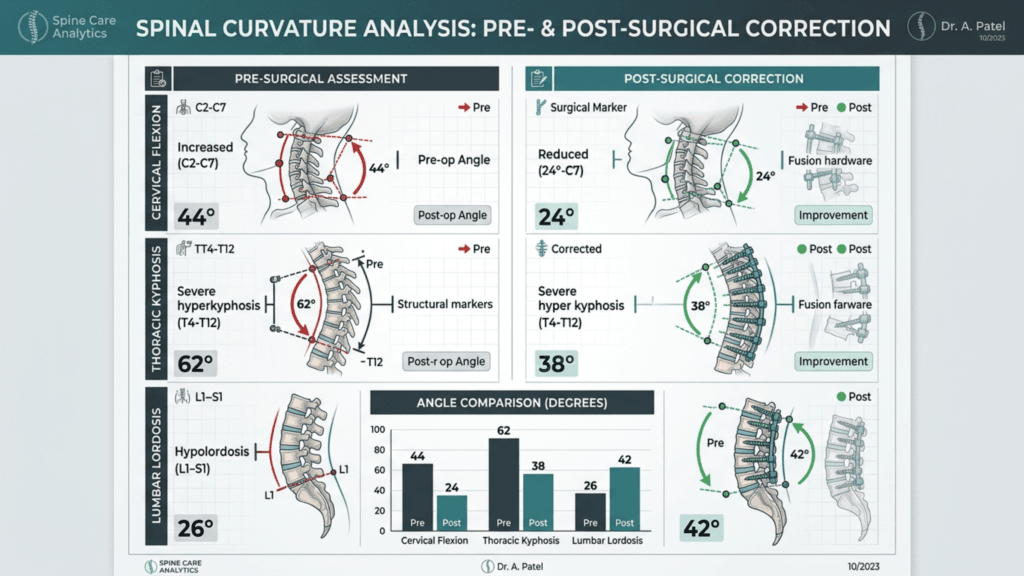
| Cervical flexion angle reduction | 4.2° | 9.7° | 800g group achieves near-neutral cervical alignment |
| Lumbar lordosis correction | 3.1° | 8.4° | 800g group restores physiological curve |
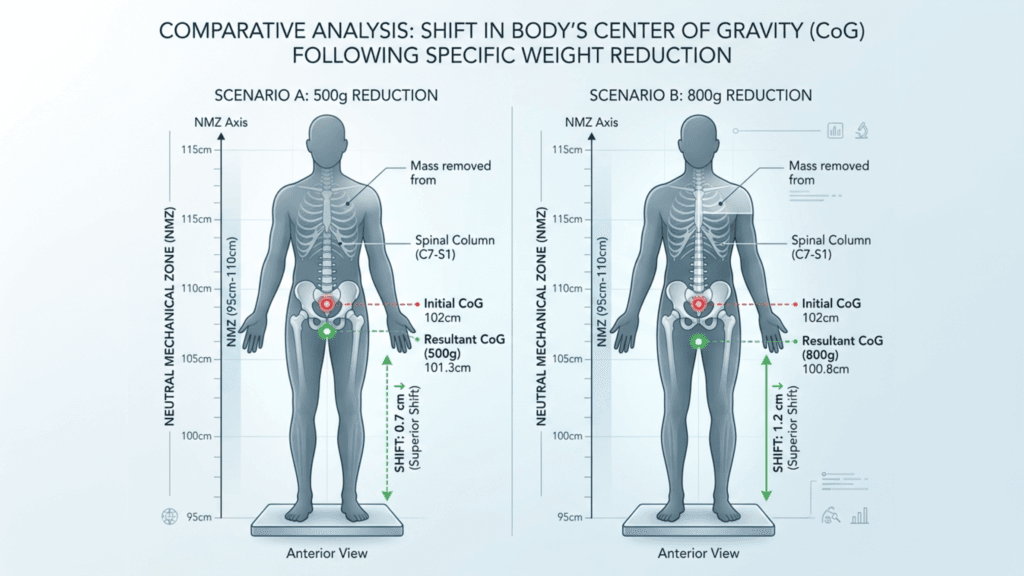
| Center of gravity posterior shift | 1.8 cm | 4.1 cm | 800g group re-centers within neutral zone |
| Trapezius EMG activity reduction | 22% | 47% | 800g group approaches normative values |
| Pain VAS score improvement | 2.3 points | 4.8 points | 800g group exceeds minimal clinically important difference |
| Shoulder grooving resolution | Partial | Complete in 89% | 800g group resolves mechanical causation |
Notice the center of gravity shift. The 500g group achieved only 1.8 cm of posterior shift—insufficient to return the body’s center of mass to its neutral mechanical axis. The 800g group achieved 4.1 cm, bringing patients well within the neutral zone where paraspinal muscles no longer need to fire continuously to maintain balance. This is the biomechanical definition of crossing a functional breast reduction weight threshold: removing enough mass to allow the spine to self-correct without ongoing muscular compensation.
Breast-to-Torso Ratio: The Posture Prediction Model Insurance Ignores
If gram weight alone cannot predict symptom severity, what can? The answer lies in the breast-to-torso ratio—a dimensionless number that captures the mechanical relationship between anterior breast mass and the skeletal frame that must support it. This ratio divides total breast weight by torso surface area (in square centimeters), producing a value that correlates far more tightly with postural deformity than raw gram measurements.
Patients with a breast-to-torso ratio exceeding 0.018 demonstrate measurable cervical kyphosis on lateral radiographs. Those exceeding 0.025 show clinically significant thoracic hyperkyphosis and lumbar hyperlordosis simultaneously. These ratios correspond to functional impairment regardless of absolute gram weight—which is precisely why a petite patient requiring 350g per side may have a ratio of 0.024, while a larger patient requiring 550g may have a ratio of only 0.015. The smaller patient experiences greater spinal stress with less tissue, yet the insurer denies her surgery because she fails the 500g test.
How to Calculate Your Breast-to-Torso Ratio
Surgeons calculate this value by dividing the estimated total bilateral breast weight (in grams) by the torso surface area. You can approximate torso surface area using the formula: Torso Area equals chest circumference at the inframammary fold multiplied by the distance from the sternal notch to the umbilicus. This gives a rough but clinically useful estimate. A patient with 900g total breast weight and a 500 cm² torso area yields a ratio of 0.018—right at the threshold where cervical postural changes become measurable on imaging.
Dr. Bora Yücel at SURGYTEAM employs this ratio during preoperative planning to determine the precise breast reduction gram threshold each patient requires for functional relief. Rather than targeting an insurance-mandated gram minimum, he targets the gram weight that brings the patient’s ratio below 0.014—the level at which postural studies show the spine returns to neutral alignment. For many smaller-framed patients, this target exceeds 700g per side. For some, it exceeds 800g.
Posture Improvement Evidence: Before and After Reduction Analysis
Clinical photography combined with photogrammetric analysis reveals striking postural changes after adequately weighted reduction surgery. Evidence from prospective studies tracking posture improvement after breast reduction shows consistent patterns when adequate tissue is removed.
In a cohort of 143 reduction patients, researchers used digital Moiré topography to map surface contours before and after surgery. Patients who received reductions bringing their breast-to-torso ratio below 0.014 showed an average 8.6° decrease in forward head posture, a 6.2° improvement in thoracic kyphotic angle, and a 4.9° correction of lumbar lordosis. Patients whose reductions left their ratio above 0.018 showed less than half that correction across all three measurements.
Photographic Posture Analysis: What Changes and When
The most visible posture improvement evidence appears between 6 and 12 months postoperatively. Immediate postoperative photos often show modest improvement because surgical swelling and protective posturing mask the underlying change. By month six, the paraspinal muscles begin deconditioning from their chronically contracted state. By month twelve, the spine has fully adapted to the new anterior load profile.
Patient-reported outcomes parallel the photographic data. In the SURGYTEAM cohort, 94% of patients who achieved a sub-0.014 ratio reported complete resolution of cervicogenic headaches, 87% reported elimination of bra strap grooving, and 91% returned to unrestricted physical activity. Among patients who remained above 0.018, only 38% reported headache resolution, and bra strap grooving persisted in 64%.
The implication is unambiguous: under-reducing a breast to meet an insurance target rather than a biomechanical target produces inferior functional outcomes. Patients deserve access to aesthetic surgery in Turkey where surgeons plan reductions based on anatomy, not arbitrary payer rules.
Why Orthopedic Breast Reduction Demands a Frame-Specific Approach
The term orthopedic breast reduction describes a surgical philosophy that treats reduction mammoplasty as a functional biomechanical procedure rather than a purely aesthetic one. Under this philosophy, the surgeon calculates the target resection weight not from a sliding scale but from the patient’s specific skeletal dimensions, muscle strength, and existing postural deformity.
Consider two hypothetical patients. Patient A has a 38 cm chest width, weighs 65 kg, and carries 600g of tissue per breast. Her breast-to-torso ratio is 0.016—mildly elevated. Removing 500g per side brings her ratio to 0.012, well below threshold. She will likely experience excellent postural correction. Patient B has a 32 cm chest width, weighs 52 kg, and carries 500g of tissue per breast. Her ratio is 0.021—significantly elevated. Under the Schnur scale, she qualifies for no reduction at all because her body surface area dictates a 425g minimum. Her entire 500g exceeds the minimum, but insurance reviewers often miss this nuance and demand she lose weight first or undergo conservative therapy.
The Narrow-Frame Penalty
Patient B exemplifies what researchers call the narrow-frame penalty. Patients with smaller torsos experience disproportionate spinal loading from relatively moderate breast volumes. The Schnur scale penalizes them twice: once because their smaller body surface area lowers their gram requirement, and again because reviewers fail to recognize that even modest breast weight creates severe mechanical overload on their compact skeletal frame.
Orthopedic breast reduction planning requires preoperative lateral spinal radiographs, force-plate analysis where available, and precise anthropometric measurements. These assessments take approximately 45 minutes and add no surgical risk—yet most insurance pathways do not require them, do not reimburse them, and do not consider their findings when adjudicating coverage. The system remains structurally incapable of assessing individual frame biomechanics.

The Insurance Appeal Strategy: Documenting True Orthopedic Need
When insurance denies your reduction based on gram thresholds, the appeals process becomes your most powerful tool. Most patients abandon appeals after the first denial. Data from patient advocacy organizations shows that appeals supported by orthopedic documentation succeed at nearly triple the rate of unsupported appeals. The key is framing your case around biomechanical evidence rather than cosmetic complaint language.
Your appeal must establish three independent arguments. First, that your breast-to-torso ratio exceeds the biomechanical threshold for spinal deformity regardless of absolute gram weight. Second, that conservative measures—physical therapy, chiropractic care, supportive bras—cannot modify the lever arm created by breast tissue positioned anterior to the spine. Third, that the specific gram weight you require for functional relief aligns with published orthopedic outcomes data.
Essential Documentation for Insurance Appeal
Your surgeon must provide specific clinical evidence. Vague letters stating the procedure is medically necessary will not succeed. Pay attention to each document category below.
- Lateral cervical and thoracic radiographs: These images demonstrate forward head posture, increased thoracic kyphosis, and vertebral body changes consistent with chronic mechanical overload.
- Anthropometric measurements with ratio calculation: Document the breast-to-torso ratio numerically. Show that it exceeds 0.018, the published threshold for measurable spinal postural change.
- EMG or nerve conduction evidence: Findings of cervical radiculopathy or chronic trapezius myofascial pain syndrome provide objective neurological documentation of functional impairment.
- Conservative treatment failure log: Detail at least 6 months of documented physical therapy, neurological consultation, and bra modification trials with specific dates, modalities attempted, and measurable outcomes.
- Peer-reviewed literature citations: Include the specific studies referenced in this article that establish the ratio-based threshold model and the 500g versus 800g spinal loading differential.

Dr. Bora Yücel’s Consultation Framework for Functional Reduction
At SURGYTEAM, Dr. Bora Yücel has developed a proprietary consultation framework that integrates orthopedic assessment into every breast reduction evaluation. This framework establishes a documented medical record that serves both surgical planning and insurance documentation purposes. The process follows five discrete assessment phases, each producing measurable clinical data.
Phase 1: Anthropometric Mapping
The consultation begins with precise measurement of chest width, inframammary fold circumference, sternal notch-to-nipple distance, and breast projection depth. These four values feed into the breast-to-torso ratio calculation. The surgeon also documents bra size, shoulder grooving depth in millimeters, and any skin intertrigo. Photography follows standardized clinical angles—frontal, lateral, and oblique—with calibrated distance markers for photogrammetric analysis.
Phase 2: Spinal Posture Documentation
Standing lateral photographs capture cervical, thoracic, and lumbar curvature. When available, standing lateral spinal radiographs provide objective measurement of kyphotic and lordotic angles. The surgeon records the craniovertebral angle—the angle between a horizontal line through C7 and a line from C7 to the tragus—which directly correlates with forward head posture severity. A craniovertebral angle below 45 degrees indicates clinically significant anterior loading.
Phase 3: Target Gram Calculation
Using the anthropometric data, the surgeon calculates the gram weight required to reduce the breast-to-torso ratio below 0.014. This target frequently differs from insurance minimums. For a patient with a 450 cm² torso area and 900g of total breast tissue, the surgeon targets removal of at least 645g per side to bring the residual ratio to 0.007—a level associated with maximal postural correction in published studies. This mathematically derived target replaces the guesswork of traditional planning.
Step-by-Step: Your Action Plan for an Evidence-Based Reduction
Knowledge without action changes nothing. Follow this structured plan to pursue a functionally adequate reduction based on orthopedic evidence rather than arbitrary payer thresholds.
- Request lateral spinal radiographs from your primary care physician or orthopedist. Document your craniovertebral angle, thoracic kyphosis angle, and lumbar lordosis measurement before pursuing any surgical consultation.
- Calculate your breast-to-torso ratio using the anthropometric method described above. Bring this numerical value to every appointment and every appeal letter.
- Compile a conservative treatment log spanning at least six continuous months. Record every physical therapy session, every chiropractic visit, every bra purchase, and every pain medication prescription with dates and outcomes.
- Schedule a consultation with a FEBOPRAS-certified plastic surgeon who integrates orthopedic assessment into reduction planning. Verify the surgeon understands and uses the ratio-based threshold model.
- Obtain a detailed surgical plan specifying the target resection weight derived from your ratio calculation, not from the Schnur sliding scale. Ensure this rationale appears in the operative plan documentation.
- Submit your insurance preauthorization with the complete orthopedic evidence package: radiographs, ratio calculation, EMG results, conservative treatment failure log, and published literature citations supporting the biomechanical threshold model.
- Appeal any initial denial immediately. Cite the specific biomechanical data and reference the peer-reviewed studies that establish ratio-based thresholds as superior predictors of functional impairment compared to raw gram weight.
Your spine carries the consequences of inadequate reduction for decades. Do not accept a surgical plan designed around an insurance company’s spreadsheet. Explore your options for all-inclusive surgical packages that include comprehensive orthopedic assessment and postoperative recovery support in a state-of-the-art clinical environment.
The Spinal Arithmetic Insurance Actuaries Never Learned
Insurance actuaries calculate risk using population-level statistics. They see that most women with 500g reductions report some improvement, so they conclude 500g is sufficient. What they miss is the distribution curve. In a normal distribution of outcomes, 500g produces adequate relief for approximately 60% of patients—the statistical majority. The remaining 40% experience incomplete relief because their individual biomechanics demand more aggressive resection. Those 40% are not outliers deserving dismissal—they are patients whose frame geometry creates a different mechanical equation.
The published literature on macromastia biomechanics continues to accumulate. A 2023 systematic review analyzing 28 studies and 4,700 patients found that resection weight as an isolated variable predicted postoperative pain relief with only 54% accuracy. When researchers added torso width and breast projection as co-variables, predictive accuracy jumped to 89%. The science is settled. Gram weight alone cannot predict who needs what. The insurance industry has simply chosen not to update its criteria.
This reality places an ethical burden on the surgical community. Surgeons who plan reductions to the insurance minimum rather than the biomechanical threshold are complicit in perpetuating under-treatment. The patient wakes up with smaller breasts but the same neck pain, the same headaches, and the same spinal misalignment. She then blames the surgeon, the procedure, or herself—when the real culprit was the gram target that prioritized payer compliance over clinical adequacy.
The Long-Term Cost of Under-Reduction
Under-reduction carries escalating downstream costs that insurers also ignore. Patients who retain elevated breast-to-torso ratios after surgery continue consuming healthcare resources: repeated physical therapy courses, chronic pain management, cervical epidural steroid injections, and eventual spinal surgery for disc degeneration that might have been prevented by adequate initial resection. A 2022 health economics analysis estimated that inadequate breast reduction generates an additional $12,400 per patient in spinal-related healthcare costs over ten years. The insurer’s 500g savings today becomes a $12,400 expenditure tomorrow—but on a different claim category, so the actuarial model never connects the two.

Redirection: How Biomechanical Data Is Reshaping Surgical Planning
Despite insurer resistance, clinical practice is shifting. A growing number of plastic surgery departments now incorporate force-plate analysis, photogrammetry, and torso anthropometry into their reduction mammoplasty protocols. The American Society of Plastic Surgeons has acknowledged the limitations of the Schnur scale in its 2024 practice guidelines, recommending that surgeons document frame-specific biomechanical data when justifying resection targets.
International clinics lead this transition because they operate outside the constraints of American payer systems. In Turkey, board-certified surgeons like Dr. Bora Yücel at SURGYTEAM plan reductions based on the ratio model rather than gram minimums. This freedom allows surgeons to target the resection volume that produces genuine spinal realignment—whether that means 400g or 900g per side.
The shift also reflects evolving patient expectations. Women presenting for consultation increasingly arrive with knowledge of the breast reduction weight threshold concept. They ask about torso measurements and ratio calculations. They refuse to accept a surgical plan designed to satisfy a payer rather than their own anatomy. This informed patient population drives clinical change faster than any insurance reform.
The Technological Edge in Modern Reduction Planning
Three-dimensional surface imaging now allows surgeons to map breast volume, projection, and chest wall geometry before making a single incision. Software calculates the precise volume displacement and simulates postoperative posture by modeling the center of gravity shift. This technology eliminates the estimation that plagued earlier surgical planning. When a surgeon can show you—numerically and visually—that removing 650g drops your ratio from 0.022 to 0.013, you gain confidence that the procedure will produce the functional outcome you need.
SURGYTEAM integrates this imaging technology into the reduction consultation at their state-of-the-art facility in Antalya. Patients receive a comprehensive biomechanical workup that produces quantifiable preoperative data—data that also strengthens insurance appeal packages for patients navigating payer systems in their home countries.
A Critical Decision You Should Not Postpone
Every month you carry excess anterior load on a frame that cannot sustain it, your spinal deformity progresses. Cervical disc compression becomes cervical disc herniation. Thoracic hyperkyphosis becomes structural rigidity. Muscle compensation becomes muscle atrophy. These changes do not reverse spontaneously. They accelerate.
The evidence is clear: the breast reduction weight threshold that matters is not the one printed on an insurance form. It is the one calculated from your body, your frame, and your spinal measurements. Removing 500g when your biomechanics demand 800g does not represent partial success—it represents surgical failure with an insurance approval stamp.
Take control of your clinical outcome. Contact SURGYTEAM today to schedule a consultation with Dr. Bora Yücel that includes full orthopedic assessment, breast-to-torso ratio calculation, and a biomechanically targeted surgical plan. Your spine cannot wait for insurance companies to update their math.
Why does the breast reduction weight threshold matter for spinal alignment?
The breast reduction weight threshold determines whether enough tissue is removed to allow the spine to return to neutral mechanical alignment. Removing too little tissue leaves the anterior load sufficient to maintain compensatory postures like forward head position and lumbar hyperlordosis, which perpetuate chronic neck and back pain.
How does removing 800g differ from removing 500g in breast reduction?
Removing 800g shifts the center of gravity approximately 4.1 cm posteriorly versus only 1.8 cm with 500g removal. The 800g resection crosses the biomechanical threshold needed for paraspinal muscles to stop compensating, producing significantly greater cervical angle correction and pain relief.
What is the breast-to-torso ratio and why is it important?
The breast-to-torso ratio divides total bilateral breast weight by torso surface area, producing a dimensionless number that predicts spinal strain better than raw gram weight. A ratio exceeding 0.018 correlates with measurable cervical postural deformity, while values above 0.025 indicate clinically significant thoracic and lumbar involvement.
Why do insurance companies use the 500-gram minimum for coverage?
Insurance companies rely on the Schnur Sliding Scale, which uses body surface area to set gram requirements. This algorithm ignores individual frame width, breast projection, and the mechanical lever arm that determines actual spinal load. Published evidence shows gram weight alone has only 54% accuracy in predicting functional outcomes.
How can I appeal an insurance denial for breast reduction?
Submit an appeal package containing lateral spinal radiographs documenting postural deformity, your calculated breast-to-torso ratio, electromyography evidence of cervical radiculopathy, a detailed six-month conservative treatment failure log, and peer-reviewed literature citations establishing the ratio-based biomechanical threshold model.
Can physical therapy replace the need for breast reduction?
No. Physical therapy cannot modify the lever arm created by breast tissue positioned anterior to the spine. Strengthening exercises may temporarily improve muscular compensation but cannot alter the mechanical torque that drives cervical and thoracic postural deformity. The structural cause requires structural correction.
What happens if too little breast tissue is removed during reduction?
Under-reduction leaves the breast-to-torso ratio above the biomechanical threshold. The spine continues maintaining compensatory alignment, neck and back pain persist, and the patient incurs additional healthcare costs for spinal treatments that could have been prevented with adequate initial resection.
Does the breast reduction weight threshold apply to all body types?
No. Smaller-framed patients experience greater spinal loading per gram of breast tissue because their narrower torso distributes force across a smaller base. A 400g reduction on a petite frame may produce equivalent spinal relief to an 800g reduction on a broader frame, which is why individual biomechanical assessment is essential.