
Why does your upper body look worse after a lower body lift? Half of all circumferential lift patients discover an unwelcome reality: their lower body results trigger upper body skin issues they never noticed before. They walk into surgery expecting one transformative operation, then discover their body demands a second one exactly nine months later.
Circumferential body lift staging is not a surgical upsell or a marketing invention. It is a biological necessity rooted in how your skin behaves after a lower body lift. The phenomenon, called accordioning, explains why tissue redistribution after massive weight loss makes a planned second surgery the rule rather than the exception. This guide reveals the tissue redistribution cycle, the nine-month tissue equilibrium timing, and why staging protects your safety and your result.

جدول المحتويات
The Biology of Circumferential Body Lift Staging: Why Your Skin Refuses to Cooperate
Massive weight loss leaves behind a garment of skin that hangs vestigially across your torso, flanks, and thighs. You lost the fat it once held, but the skin envelope remained. A circumferential body lift removes that redundant tissue at the waistline, pulling everything upward like a tightened belt. That mechanical action sounds simple. The biology tells a different story.
Your skin attaches to deeper structures through fibrous bands called retaining ligaments. These bands anchor skin to bone and fascia at predictable points—the ribs, the iliac crest, the scapulae, the sacrum. When a surgeon pulls tissue upward during a lower body lift, those anchoring points do not release uniformly. The lower torso shifts dramatically. The upper torso shifts partially. The chest, back, and arms barely shift at all because their retaining ligaments remain intact.
The Retaining Ligament Hierarchy:
- Lumbodorsal Fascia Anchors: Release during lower body lift, allowing significant upward tissue movement.
- Iliac Crest Anchors: Partially release, permitting moderate redistribution along the hip and flank.
- Scapular and Costal Anchors: Remain fixed. Skin above the rib cage cannot travel downward to meet the newly elevated lower tissue.
This differential mobility creates slack. The lower body tightens beautifully. The upper body loosens visibly. Post-bariatric skin redistribution does not happen instantly at the operating table. It unfolds over months as gravity, scar maturation, and tissue creep interact. That unfolding process dictates why staging works and single-stage attempts fail.
Accordioning After Body Lift: The Phenomenon Nobody Warns You About
Picture an accordion. Pull the bottom end downward, and the folds concentrate at the top. Release it, and the folds redistribute. Your post-weight-loss body behaves similarly. A lower body lift pulls the abdominal and hip tissues upward, but the skin above the waistline has nowhere to go. It buckles, folds, and piles up across the upper abdomen, lateral chest, and inframammary crease.
Patients call this new crease the second rolls. Surgeons call it proximal redundancy. Regardless of terminology, accordioning after body lift represents the most common reason patients pursue a second-stage procedure. You cannot predict its severity preoperatively because skin elasticity measurements fail to account for how retaining ligaments release differentially under tension.
Why Accordioning Worsens During Months 1 Through 6:
- Scar Contracture: The circumferential scar at your waistline thickens and contracts during the first three months. This contraction pulls lower tissue even tighter while pushing upper tissue into deeper folds.
- Gravitational Creep: Skin above the waistline slowly sags under its own weight. Without the counterbalancing weight of lower redundant skin, the upper torso skin drifts downward and bunches.
- Postural Shifts: Patients stand taller after a lower body lift because the abdominal load disappears. This erect posture pulls the thorax upward relative to the pelvis, exaggerating the upper skin redundancy.
Accordioning peaks around month six. That is when scar contracture reaches its maximum and gravitational creep has had time to manifest. This timing matters because it determines when surgeons can safely intervene with a second surgery.
The 9-Month Tissue Equilibrium Timing: When Your Body Finally Settles
Tissue equilibrium timing represents the critical window when your skin, scar, and underlying soft tissue reach a stable configuration after a lower body lift. Before this point, the tissue continues shifting. Operating during active redistribution means your surgeon operates on a moving target, increasing the risk of overcorrection or undercorrection.
Research on wound healing biology reveals a clear timeline. Collagen synthesis peaks at three weeks post-injury, transitions to remodeling at six weeks, and reaches functional maturity at approximately nine months. During remodeling, collagen fibers reorganize from chaotic type III fibers into organized type I fibers. The scar softens. The surrounding skin relaxes. The tissue settles into its final position.
The Tissue Equilibrium Timeline:
- Months 0 to 3: Active inflammation. Swelling dominates. Skin appears tighter than the final result. Accordioning develops rapidly. No reliable assessment possible.
- Months 3 to 6: Proliferative phase ends. Scar contracture peaks. Accordioning reaches its maximum severity. Preliminary assessments become possible but remain unreliable.
- Months 6 to 9: Maturation phase accelerates. Scar softens visibly. Skin redistribution stabilizes. Surgeons can now map redundant tissue boundaries with accuracy.
- Month 9 and Beyond: Tissue reaches equilibrium. Upper body redundancy no longer changes. Second-stage body contouring can proceed with predictable outcomes.
Operating before month nine carries real consequences. A surgeon who removes upper body skin at month five faces an unpredictable outcome because the tissue continues shifting for four more months. By month nine, the body speaks its final language. Dr. Mustafa Keleş at SURGYTEAM uses this biology to his advantage, planning second-stage procedures only after confirming tissue equilibrium through clinical assessment and photographic comparison.
Second-Stage Body Contouring: What the 50 Percent Statistic Really Means
The statistic that one in two circumferential lift patients needs a second surgery sounds alarming. Let us examine what drives this number. Studies of post-bariatric body contouring patients show that 48 to 55 percent of individuals who undergo a lower body lift subsequently request or require a second-stage procedure. These procedures include upper body lifts, abdominoplasty revisions, brachioplasty, and mastopexy to address tissue migration.
Critically, this statistic does not indicate surgical failure. It indicates biological reality. A single circumferential lift addresses the lower torso exclusively. It was never designed to correct upper body redundancy. Patients who understand this before their first surgery report dramatically higher satisfaction scores because they planned for staging from the beginning rather than discovering it as a surprise.
Most Common Second-Stage Procedures After Lower Body Lift:
- Upper Body Lift (Belt Lipectomy Reversal): Addresses lateral chest folds, epigastric redundancy, and inframammary crease distortion. Most commonly requested second-stage procedure.
- عملية شد الذراعين: Corrects upper arm skin sagging that becomes visually prominent after the lower body tightens. Learn more about this procedure on our arm lift page.
- Mastopexy or Augmentation Mastopexy: Repairs breast ptosis exacerbated by upward tissue migration. See our augmentation mastopexy guide for combined lift and volume restoration approaches.
- Abdominoplasty Revision: Refines the lower scar, removes dog ears, and addresses residual epigastric laxity. Our tummy tuck resource covers revision considerations.
Second-stage body contouring is not optional for many patients. It is the completion of a journey that a single surgery cannot finish. The body demands it, and excellent surgical planning anticipates it.
Post-Bariatric Skin Redistribution: The Science of Moving Tissue
Post-bariatric skin redistribution follows predictable patterns that experienced surgeons can map before surgery. Understanding these patterns transforms staging from an unexpected complication into a planned treatment arc. The key insight is this: your skin does not stretch uniformly after weight loss, and it does not tighten uniformly after surgery.
Massive weight loss—defined as losing 50 percent or more of excess body weight—destroys the collagen and elastin network in your dermis. The skin loses recoil capacity. It hangs like a deflated balloon, and pulling one section of that balloon tight simply shifts the excess elsewhere. This mechanical reality drives every surgical decision in post-bariatric contouring.
The Four Redistribution Vectors:
- Cephalad Vector (Upward): A lower body lift pulls tissue upward. The dominant vector. Creates accordioning across the upper abdomen and inframammary crease.
- Medial Vector (Inward): Circumferential tightening pulls lateral tissue medially. This reduces flank width but pushes excess skin toward the midline, creating epigastric bulging.
- Caudal Vector (Downward): After the lower lift settles, gravity pulls upper body skin downward over the new circumferential scar. This compounds accordioning at the waistline.
- Rotational Vector: Tissue migration around the torso follows spiral patterns due to the oblique orientation of retaining ligaments. This explains why excess often appears asymmetrically, with one side of the upper torso more redundant than the other.
Surgeons who ignore these vectors end up chasing redundancy rather than directing it. FEBOPRAS-certified tissue viability assessment, as practiced by Dr. Keleş, evaluates each vector preoperatively and designs incision placement to leverage rather than fight natural redistribution forces.
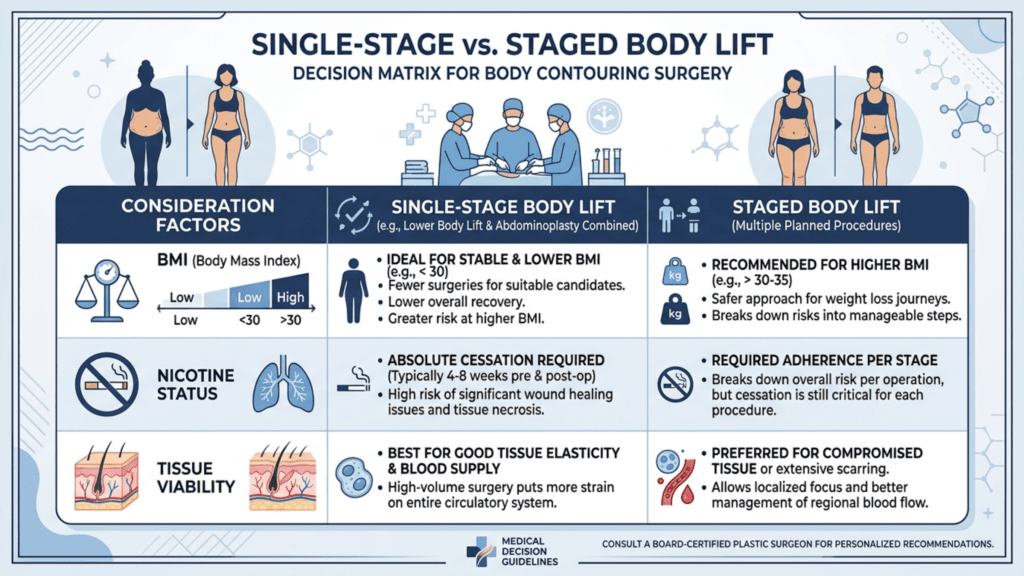
Single-Stage vs. Staged Body Lift: Decision Criteria That Determine Your Outcome
Some patients can undergo a single-stage circumferential lift addressing both upper and lower torso. Most cannot. The decision between single-stage and staged reconstruction depends on objective clinical criteria, not patient preference alone. Dr. Keleş evaluates each patient against specific benchmarks before recommending an approach.
Single-Stage Candidacy Requirements:
- Redundancy Limited to One Zone: Skin excess confined primarily to the lower torso (waistline and below) without significant upper body involvement.
- BMI Below 28 at Surgical Weight: Higher BMI increases operative time, complication rates, and tissue tension beyond safe single-stage limits.
- Nonsmoker With No Comorbidities: Wound healing demands excellent tissue oxygenation. Diabetes and smoking disqualify single-stage candidacy.
- Tissue Viability Score Above 7: Dr. Keleş scores tissue viability on a validated 10-point scale. Scores below 7 necessitate staging.
Patients who meet all four criteria may proceed with a single-stage procedure. However, most massive weight loss patients fail at least one criterion, making staged reconstruction the standard of care. The table below summarizes the decision framework.

Comparative Decision Framework: Single-Stage vs. Staged Body Lift Surgery
The following table presents the clinical decision criteria that determine whether a patient should undergo single-stage or staged circumferential body lift surgery. Each criterion carries weight in the final surgical plan.
| Decision Criterion | Single-Stage Candidate | Staged Candidate |
|---|---|---|
| Skin Excess Distribution | Lower torso only (below waistline) | Lower and upper torso with lateral chest folds |
| Preoperative BMI | Below 28 | 28 to 32 or higher |
| Tissue Viability Score | 7 or above on 10-point scale | Below 7 (compromised perfusion) |
| Nicotine Status | Nonsmoker for 12+ months | Current or recent smoker |
| Comorbidity Load | None (ASA Class I) | Controlled diabetes, hypertension, or sleep apnea |
| Estimated Operative Time | Under 5 hours | Exceeds 5 hours per stage |
| Accordioning Risk | Low (minimal upper body laxity) | High (visible supra-waistline redundancy) |
| Revision Probability | Under 15 percent | 48 to 55 percent (planned in staging protocol) |
This framework reveals why approximately half of circumferential lift patients fall into the staged category. Their anatomy, health profile, and tissue quality demand a phased approach. Attempting single-stage surgery in these patients produces higher complication rates, wider scars, and unpredictable contour outcomes.
Lower Then Upper Body Lift Sequence: Why Order Matters More Than Timing
The sequence of your staged procedures determines your final result. A lower then upper body lift sequence is not arbitrary. It follows biomechanical logic: correcting the lower torso first creates the foundation against which upper body skin must conform. Reversing the sequence produces disastrous results.
Performing an upper body lift first removes skin from the chest and upper back. When the surgeon subsequently performs the lower body lift, upward tissue migration pulls against already-tightened upper tissue. The result is excessive tension at the waistline, widened scars, and potential wound dehiscence. The lower then upper body lift sequence prevents this by establishing the fixed point (lower body position) first and then adjusting the upper body to match it.
Why Lower-First Sequencing Dominates:
- Foundation First: The lower body defines the tension baseline. Upper tissue adjusts to this baseline naturally.
- Predictable Accordioning: By correcting the lower body first, surgeons can observe and measure the exact amount of upper body accordioning before planning the second stage.
- Scar Placement Control: Lower-first surgery places the circumferential scar at or below the waistline. The upper body scar can then be hidden in the inframammary or axillary crease.
- Vascular Safety: Each stage preserves independent blood supply territories. Staging avoids operating on adjacent vascular zones simultaneously, reducing necrosis risk.
This sequencing logic applies universally across post-bariatric contouring centers of excellence. SURGYTEAM formalizes it into a structured three-phase model that removes guesswork from the staging process.
SURGYTEAM’s 3-Stage Sequencing Model: Lower, Upper, Refinement
Dr. Mustafa Keleş developed the SURGYTEAM 3-stage sequencing model specifically for massive weight loss patients who require full body contouring. This model divides the contouring journey into three distinct phases, each with defined goals, timing, and completion criteria.
Stage 1: Lower Body Foundation (Month 0)
The first stage addresses the abdomen, flanks, hips, and buttocks through a circumferential lower body lift. This is the highest-impact procedure in the sequence because it removes the largest volume of redundant skin and establishes the tissue baseline for all subsequent stages. Dr. Keleş often combines this stage with a رفع المؤخرة البرازيلية fat transfer to restore gluteal projection lost during weight loss.
- Procedures Included: Circumferential abdominoplasty, gluteal lift, mons pubis reduction, lateral thigh tightening.
- Operative Time: 4 to 5 hours under general anesthesia.
- استعادة: 2 weeks minimum before light activity. Full activity at 6 weeks.
- Completion Criteria: Scar matured, swelling resolved, accordioning pattern documented through photography.
Stage 2: Upper Body Correction (Month 9 to 12)
After the lower body reaches tissue equilibrium at approximately nine months, the second stage corrects upper body redundancy caused by accordioning. This is the stage that one in two patients requires. It targets the lateral chest folds, epigastric laxity, and inframammary crease distortion.
- Procedures Included: Upper body lift (reverse belt lipectomy), brachioplasty, and mastopexy or augmentation mastopexy.
- Operative Time: 3 to 5 hours depending on combined procedures.
- Key Decision: Whether to combine upper body lift with breast surgery or stage them separately. Dr. Keleş evaluates tissue viability scores to determine safe combination boundaries.
- Completion Criteria: Upper body skin taut without visible folds, scar softening initiated, patient cleared for final refinement assessment.
Stage 3: Refinement (Month 18 to 24)
The final stage addresses residual irregularities that become apparent only after both major stages settle completely. Patients who achieve excellent results after Stage 2 may not need this phase. Those with thick scars, dog ears, or residual laxity benefit from targeted revisions.
- Procedures Included: Scar revision, dog ear excision, targeted liposuction, minor skin excision under local anesthesia.
- Operative Time: 1 to 2 hours, often under local anesthesia with sedation.
- Completion Criteria: Patient satisfaction confirmed, scars mature and faded, no residual functional skin complaints.
This three-stage model gives patients a complete roadmap. Rather than reacting to each surprise development, they follow a predetermined plan with clear milestones and expectations. The model reduces anxiety, manages costs predictably, and produces superior aesthetic outcomes.
Tissue Viability Scoring: Predicting Success Before the First Incision
Tissue viability scoring measures the blood supply quality of your skin and subcutaneous tissue before surgery. Dr. Keleş uses a validated 10-point assessment that evaluates five parameters: capillary refill time, skin turgor, nicotine exposure history, BMI stability, and prior surgical scarring. Each parameter receives a score from zero to two.
The 5-Parameter Tissue Viability Score:
- Capillary Refill Time (0 to 2 points): Under 2 seconds earns 2 points. Two to 4 seconds earns 1 point. Over 4 seconds earns 0 points. Measures microcirculatory health.
- Skin Turgor (0 to 2 points): Immediate recoil earns 2 points. Delayed recoil earns 1 point. Tenting earns 0 points. Indicates dermal elasticity status.
- Nicotine Exposure (0 to 2 points): Never smoked earns 2 points. Quit more than 12 months ago earns 1 point. Active or recent smoker earns 0 points. Nicotine causes vasoconstriction that impairs wound healing.
- BMI Stability (0 to 2 points): Stable weight for 12+ months earns 2 points. Stable for 6 months earns 1 point. Less than 6 months earns 0 points. Weight fluctuation destabilizes tissue planes.
- Prior Surgical Scarring (0 to 2 points): No prior abdominal incisions earns 2 points. Minor scarring earns 1 point. Multiple or vertical incisions earn 0 points. Scarring disrupts perforator blood supply.
A total score of 7 or higher supports aggressive single-stage attempts or combined Stage 1 and Stage 2 procedures. A score between 4 and 6 mandates staging with at least three months between procedures. A score below 4 requires extended staging intervals of six months or more between each phase. This scoring system transforms subjective clinical impressions into objective surgical planning data.
Realistic Timeline Planning: Your 24-Month Body Contouring Journey
Post-bariatric body contouring spans approximately 18 to 24 months from first surgery to final result. Attempting to compress this timeline creates complications. Extending it beyond 24 months introduces new challenges: aging skin loses additional elasticity, weight may fluctuate, and motivation wanes. The optimal timeline balances biology with practical life planning.
Key Timeline Milestones:
- Month 0: Stage 1 surgery. Lower body lift with or without concurrent liposuction.
- Months 1 to 3: Initial healing. Swelling dominates. Compression garments mandatory. Limited mobility expected.
- Months 3 to 6: Scar contracture peaks. Accordioning becomes visually apparent. Begin photographic documentation for Stage 2 planning.
- Months 6 to 9: Tissue equilibrium approaches. Scar begins softening. Final accordioning pattern emerges.
- Month 9 to 12: Stage 2 surgery window. Upper body lift, brachioplasty, and breast procedures performed.
- Months 12 to 18: Stage 2 healing and maturation. Upper body tissue settles.
- Month 18 to 24: Refinement stage. Minor scar revisions and touch-ups if needed.
Medical tourism patients face additional planning complexity. Travel logistics, recovery accommodations, and follow-up scheduling require coordination with your surgical team. SURGYTEAM provides comprehensive support for international patients through structured all-inclusive packages that handle logistics so you can focus on healing.
Actionable Roadmap: Planning Your Staged Body Lift Successfully
Embarking on circumferential body lift staging requires deliberate preparation across multiple domains. Follow this seven-step roadmap to set yourself up for the best possible outcome.
- Achieve weight stability. Maintain your target weight for at least 12 consecutive months. Weight fluctuations during the staging process distort tissue equilibrium and compromise every subsequent surgery.
- Quit nicotine completely. Stop all nicotine products—including patches and gum—at least 8 weeks before your first surgery. Nicotine impairs wound healing for weeks after cessation and remains the leading modifiable risk factor for tissue necrosis.
- Complete a tissue viability assessment. Schedule your consultation with Dr. Keleş for a full 10-point tissue viability scoring. This single evaluation determines your staging protocol, operative timing, and safety boundaries.
- Expect two stages, plan for three. Budget for both Stage 1 and Stage 2 surgery. If your body requires no refinement, consider it a bonus. Financial surprise is the leading source of patient dissatisfaction in staged contouring.
- Document your body monthly. Take standardized photographs from eight angles at the same time each month. These images reveal accordioning patterns your surgeon uses to plan Stage 2 incision placement with precision.
- Respect the 9-month milestone. Do not request Stage 2 surgery before month nine. Operating on migrating tissue wastes surgical effort and produces inferior results. Patience during this window is biologically enforced, not arbitrarily imposed.
- Arrange recovery support for each stage. Each surgery demands two weeks of assisted recovery. Arrange help, compression garments, and time off work before committing to any surgical date.
Your body completed the hardest part—losing the weight. Now give it the surgical precision it deserves. Staged circumferential body lift surgery is not a compromise. It is the protocol that delivers the result you earned. Schedule your consultation with Dr. Keleş to begin your staged body contouring plan.