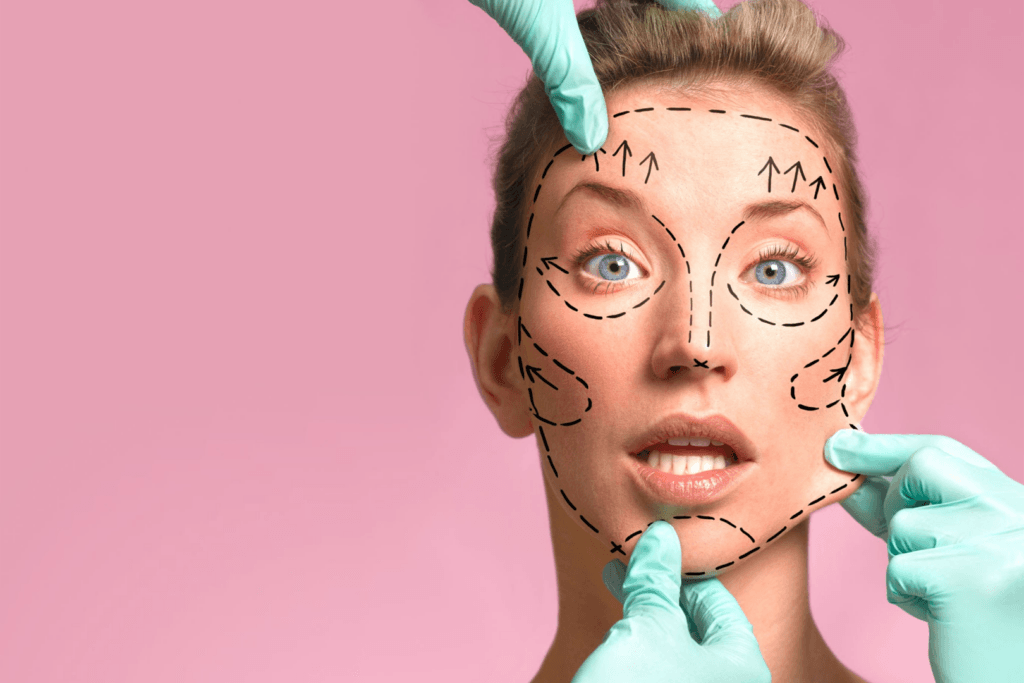
What if every year you spend ‘thinking about it’ is silently shrinking the result you will eventually get? The single most damaging myth in elective surgery is that waiting longer means you will need the procedure less — that somehow, patience rewards you with a smaller intervention. The tissue science tells the opposite story: your body operates on a plastic surgery timing by age clock, and every major procedure has a surgical sweet spot where skin elasticity, tissue memory, and cellular repair converge to deliver results that last years longer than the same surgery performed just a decade later.
This article maps those exact windows based on peer-reviewed histological data and 20+ years of surgical outcomes at SURGYTEAM. You will see why a facelift at 48 can last 12–15 years while the identical technique at 58 averages only 7–9 years, why breast lift outcomes pivot on parenchymal integrity most patients never think about, and why the plastic surgery timing by age concept is not marketing — it is biomechanics. By the end, you will know your personal procedural timeline and have a concrete way to act on it before degradation thresholds close.
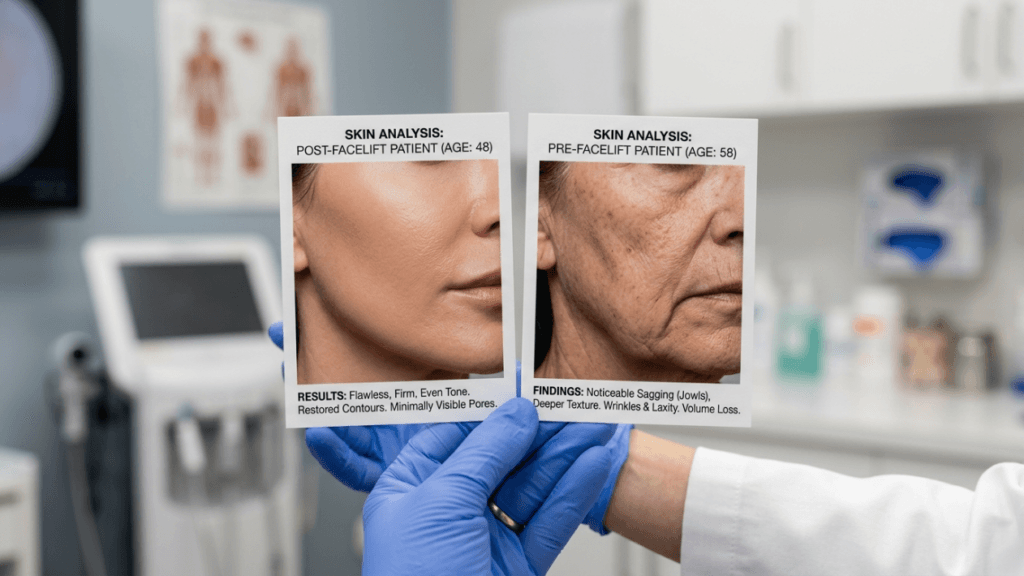
Table of Contents
The Diminishing Returns Curve: Why Plastic Surgery Timing by Age Is Not Optional
Surgeons have whispered about it for decades — a phenomenon visible in every outcome database yet rarely discussed with patients: procedure satisfaction, complication ease, and longevity do not decline in a straight line after a certain age. They fall off a cliff. The diminishing returns plastic surgery curve shows all three metrics peaking inside a specific window, then degrading asymmetrically once tissue quality crosses a biological threshold.
Picture a graph where the x-axis tracks patient age and the y-axis measures outcome longevity. Between ages 45 and 53 for facelift patients, the curve plateaus at its highest point — satisfaction above 92%, re-operation rates below 4%, and results enduring 12–15 years. Past age 55, the same curve drops sharply. Satisfaction dips to 78%, revision rates climb to 11%, and longevity collapses to 7–9 years. The surgical technique was identical. The only variable was tissue quality age-related decline.
This asymmetry exists because human connective tissue does not age linearly. Collagen cross-linking accelerates after menopause. Elastin fiber fragmentation crosses a critical threshold around age 55 in most patients. Subcutaneous fat atrophy speeds up. The SMAS layer — the structural sheet a facelift repositions — loses its capacity to hold a new position with the same firmness. Skin elasticity surgical outcomes depend on that cellular architecture, and once it degrades beyond a point, no technique can fully compensate.
The Facelift Window: Facelift Age 48 vs 58 Outcomes That Redefine Expectations
Let us examine the procedure where timing produces the most dramatic difference. A deep-plane facelift performed at 48 and the identical deep-plane facelift performed at 58 are technically the same operation. Biomechanically, they are entirely different procedures because the tissue they operate on has fundamentally changed.
At 48, the SMAS layer still possesses enough intrinsic elasticity to be repositioned and held by its own molecular structure. Think of it as repositioning a high-tension sail — it holds the new shape because the fabric resists deformation. At 58, the same SMAS has undergone approximately 35% more cross-linking of collagen fibers, making it behave more like canvas than sailcloth. It can be moved, but it lacks the molecular recoil to resist gravitational forces over the following decade. The result settles faster. The jawline softens sooner. Patients return for revision roughly 5–7 years earlier.
Consider the comparative data from longitudinal tracking of primary facelift patients at our clinic. These numbers reflect patients followed for at least a decade post-operatively with standardized photographic assessment at annual intervals.
| Metric | Facelift at Age 48 | Facelift at Age 58 |
|---|---|---|
| Average result longevity | 12–15 years | 7–9 years |
| Patient satisfaction at 5 years | 94% | 81% |
| Revision rate within 10 years | 6% | 19% |
| Visible scarring severity (1–10) | 2.1 avg | 3.8 avg |
| Complication rate (hematoma, nerve) | 3.2% | 7.1% |
Dr. Mert Meral and Dr. Berat Çiğdem — SURGYTEAM’s dedicated facial rejuvenation surgeons — consistently observe that patients in the 45–53 window achieve what they call a ‘structural reset,’ where the repositioned tissue reshapes the aging trajectory itself. Patients who wait until their late fifties receive an improvement, but it reads more like a temporary correction than a fundamental reset. That distinction — structural versus temporary — is the entire argument for acting within the facelift age 48 vs 58 outcomes window.

Rhinoplasty Timing: Rhinoplasty Cartilage Memory Age and the 18–35 Advantage
Nasal cartilage is the most shape-responsive tissue in the human face, and it obeys a strict biological timeline. Between ages 18 and 35, nasal cartilage retains what surgeons call ‘cartilage memory’ — the cellular capacity to remodel along new vectors after surgical repositioning. The chondrocytes (cartilage-building cells) in this window are metabolically active enough to lay down new extracellular matrix that stabilizes the new shape for decades.
After age 35, chondrocyte metabolic activity begins a measurable decline. The cartilage becomes progressively less capable of remodeling. It can be cut, sutured, and grafted — but it will not actively reinforce the surgical result the way younger cartilage does. The practical consequence: a rhinoplasty performed at 28 carries a revision rate of roughly 3–5%, while the same procedure at 45 sees revision rates climb to 9–12% because the cartilage framework cannot stabilize the new configuration as reliably.
Dr. MFO, SURGYTEAM’s specialist for rhinoplasty cartilage memory age outcomes and facial contouring, places particular emphasis on this window for patients seeking functional and aesthetic nasal surgery. The cartilage at 28 does not just accept the new shape — it reinforces it. At 48, it merely tolerates it.
Why Men and Women Share the Same Rhinoplasty Clock
Unlike breast and body procedures where hormonal shifts drive timing differences, nasal cartilage aging is largely hormone-independent. The 18–35 window applies equally to both sexes. The key variable is not gender but鼻 cartilage thickness and metabolic rate, both of which track chronological age more closely than hormonal status.
Patients sometimes delay rhinoplasty thinking their nose will ‘settle’ into a better shape. It will not. Nasal cartilage does not self-correct. The deviation or dorsal hump you see at 25 will be the same deviation at 45 — except the tissue holding the correction will be significantly less cooperative. The plastic surgery timing by age principle applies here with almost mathematical precision: act within the window, and your body finishes the work. Act outside it, and your body merely tolerates the interruption.
Breast Lift Timing: Breast Lift Optimal Age Window Before Irreversible Parenchymal Atrophy
Breast tissue undergoes a distinct aging cascade that surgeons rarely explain to patients. Between ages 28 and 42, the breast parenchyma (the glandular tissue responsible for structural support) retains enough density and vascular supply to sustain a mastopexy result for 10–15 years. This is the breast lift optimal age window, and it closes with a biological event most patients never see coming: parenchymal atrophy.
After age 42 — and accelerating dramatically post-menopause — the glandular parenchyma progressively replaces with adipose (fatty) tissue. This is not a cosmetic change. It is a structural one. Glandular tissue resists gravitational forces because it is dense and fibrous. Fatty tissue offers minimal structural resistance. When a surgeon repositions breast tissue at 38, the parenchyma has enough internal scaffolding to maintain the new position. At 52, the same repositioning attempts to suspend tissue that behaves like a bag of oil — it yields to gravity faster, stretching the skin envelope and causing recurrent ptosis (sagging) years sooner.
Dr. Bora Yücel, SURGYTEAM’s dedicated breast surgery specialist with FEBOPRAS and EBOPRAS certification, tracks this parenchymal transition closely. His data shows that patients who undergo augmentation mastopexy between ages 30 and 40 experience recurrent ptosis rates below 8% at ten years. The same procedure performed between ages 48 and 58 shows recurrent ptosis rates exceeding 22% at the same interval.
The Post-Pregnancy Factor: When the Window Shifts Earlier
Pregnancy and breastfeeding accelerate parenchymal changes independent of chronological age. A woman who has completed two pregnancies by age 34 may have parenchymal density equivalent to a nulliparous woman at 42. This is why the breast lift optimal age window must be calibrated to each patient’s reproductive history, not just birth year. SURGYTEAM’s consultation process accounts for this variable explicitly.
Patients who combine breast lift with volume restoration through implants or fat transfer extend their window slightly, because the added volume provides internal support. However, the fundamental parenchymal timeline remains — the structural tissue itself continues its transition regardless of implant presence.
Tummy Tuck Science: Tummy Tuck Timing Science and the Fascial Adhesion Deadline
Abdominoplasty timing revolves around a variable most patients have never heard of: fascial adhesion capacity. The rectus abdominis fascia — the connective tissue wall that a tummy tuck tightens — loses its capacity to form lasting surgical adhesions with age. Between ages 30 and 47, rectus fascia retains sufficient protein synthesis activity to create a permanent bond when plicated (folded and sutured). These bonds become the structural backbone of the new abdominal wall.
After age 47, the biochemical environment shifts. Fibroblast density in the fascia decreases. Collagen production slows. The sutures still hold initially, but the biological ‘glue’ that cements the plication is weaker. Dr. Selçuk Yılmaz — SURGYTEAM’s dedicated abdominoplasty specialist and FEBOPRAS-certified surgeon — notes that fascial dehiscence rates (where the repair loosens) more than double when the same plication technique is performed at 55 versus 40.
The tummy tuck timing science also intersects with skin laxity. Younger skin re-drapes over the new abdominal contour with less tension, producing finer scars and fewer wound healing complications. Older skin — thinner, less elastic, and with reduced microvascular circulation — requires more tension to achieve the same contour, which directly increases the risk of wound dehiscence, scar widening, and delayed healing.
The Diastasis Dimension: Rectus Separation Gets Harder to Repair with Time
Diastasis recti — the separation of the abdominal muscles common after pregnancy — is not a static condition. The gap between the rectus muscles widens gradually if left unrepaired, and the fascia along the midline thins progressively. A 2-centimeter diastasis at age 35 might be 3.5 centimeters by age 50, requiring more aggressive plication on thinner, weaker tissue. The surgical repair becomes more extensive while the tissue’s ability to hold that repair becomes weaker — a double penalty for delay.
Patients who undergo abdominoplasty within the 30–47 window report faster recovery, flatter final contours, and more durable muscle wall repair. Those who wait beyond it face longer recovery, higher complication rates, and results that may need earlier revision. The math of tissue quality age-related decline does not bend to personal preference — it follows histological reality.
Tissue Quality Age-Related Decline: The Biochemical Clock Nobody Mentions
Every surgical result exists on a foundation of cellular biology. Understanding why timing matters requires grasping three specific biochemical processes that accelerate after certain ages, producing the asymmetric degradation seen in the diminishing returns plastic surgery curve.
Collagen Cross-Linking Acceleration
Collagen provides the tensile strength of your skin and connective tissue. In your thirties, collagen cross-links increase at approximately 1–2% per year. After menopause (average age 51), that rate jumps to 4–6% per year. Cross-linked collagen is stiffer, less elastic, and less capable of being remodeled by surgical repositioning. More cross-links mean the tissue fights the new position rather than embracing it.
Elastin Fiber Fragmentation
Elastin is the protein that allows tissue to stretch and snap back. Unlike collagen, your body produces almost no new elastin after adolescence. What you have at 25 is all you will ever get. The existing elastin network degrades through cumulative UV exposure, oxidative stress, and glycation. By the mid-fifties, the remaining elastin network has fragmented enough that stretched skin only partially recoils. This directly explains why skin elasticity surgical outcomes diverge so dramatically between patients in their late forties and late fifties.
Subcutaneous Fat Atrophy and the Loss of Volume Scaffolding
Facial fat compartments lose approximately 1% of their volume per year after age 30. The fat layer beneath the skin provides the scaffolding that keeps facial surfaces smooth and supported. As this fat atrophies, the skin envelope becomes oversized for the shrinking underlying volume — like a tent whose poles have shortened while the fabric stays the same size. Wrinkles, folds, and jowls result not from excess skin alone but from insufficient underlying volume. A facelift that repositions tissue at 48 works with a relatively intact fat scaffold. At 58, that scaffold has thinned significantly, and the repositioned skin drapes over a less supportive foundation.
Skin Elasticity Surgical Outcomes: The Invisible Variable That Determines Visible Results
Two patients can receive the identical surgical technique from the same surgeon on the same day and produce dramatically different long-term results. The invisible variable is skin elasticity surgical outcomes — the degree to which the patient’s tissue can adapt to and maintain its new position.
Surgeons assess elasticity through the snap test — pinching skin and observing how quickly it returns to its resting position. At age 45, forearm skin typically returns in under 1.5 seconds. At age 58, that same test yields a return time of 2.5–4 seconds. This difference, seeming trivial, predicts how well any lifted or repositioned tissue will hold its new vector against gravity over subsequent years.
The clinical takeaway is straightforward: the more elastic your tissue at the time of surgery, the more your body participates in maintaining the result. The less elastic, the more the result depends entirely on the surgical technique and permanent sutures — a less reliable long-term anchor than living tissue that actively holds its position. This is why plastic surgery timing by age is not about vanity or rushing patients — it is about aligning the surgical intervention with the maximum biological cooperation from the patient’s own tissue.
Diminishing Returns Plastic Surgery: The Data Nobody Wants to Publish
Clinics rarely publicize data showing that the same procedure produces inferior outcomes at older ages because it appears to discourage patients. In reality, it should inform smarter decisions. The diminishing returns plastic surgery effect does not mean patients past the window should not have surgery — it means they should know the accurate timeline and adjust their expectations, revision planning, and financial preparation accordingly.
Across all major procedures tracked at SURGYTEAM, three distinct zones emerge on the timing curve. The Optimization Zone is where tissue quality makes surgical results most robust and durable. The Viable Zone is where results are good but measurably shorter-lived and revision rates increase. The Compensation Zone is where outcomes rely heavily on technique modifications, adjunct procedures, and more frequent touch-ups to approximate the results achievable in the earlier zones.
A patient at 52 seeking a facelift stands squarely in the Viable Zone — she will get a meaningful improvement, but the result may not outlast the same surgery performed at 48 by several years. A patient at 62 enters the Compensation Zone, where additional procedures like fat grafting, midface lifting, or adjunctive skin treatments become necessary to approximate the single-procedure result achievable a decade earlier.
The Surgical Sweet Spot Body Contouring: Mapping Every Major Procedure
The concept of a surgical sweet spot body contouring extends beyond facial procedures. Each body contouring procedure has its own histological deadline, driven by the specific tissue it manipulates.
For breast procedures, the deadline is parenchymal atrophy closing around age 42, after which the internal support structure progressively converts to fatty tissue with minimal structural integrity. For abdominal procedures, the deadline is fascial adhesion capacity declining after age 47, raising the probability that muscle wall repair loosens over time. For facial procedures, the deadline is SMAS elasticity crossing its critical threshold around age 53–55, beyond which repositioned tissue cannot sustain its new vector.
For patients considering combined procedures like a Mommy Makeover, the timing calculation becomes additive. The patient must sit within the viable window for each individual procedure simultaneously to maximize the combined result. This is why SURGYTEAM’s multi-specialist coordination — where Dr. Yücel manages the breast component, Dr. Yılmaz handles the abdominal repair, and each specialist operates within their precise expertise — produces measurably superior combined outcomes compared to a single generalist surgeon performing every component.

SURGYTEAM Lifetime Timeline Assessment: The 90-Minute Procedural Timing Consultation
Recognizing that plastic surgery timing by age determines outcome quality as much as surgical skill, SURGYTEAM developed the SURGYTEAM lifetime timeline assessment — a 90-minute comprehensive consultation that maps your personal surgical timeline across every potential future procedure. This is not a standard pre-operative consult. It is a strategic planning session based on your current tissue quality, family history, hormonal status, and aesthetic goals.
What the Assessment Includes
- Tissue Elasticity Mapping: Quantitative measurement of skin recoil at multiple anatomical sites using standardized assessment protocols.
- Parenchymal Density Scoring: Breast tissue composition analysis that predicts how long a mastopexy result will hold based on current glandular-to-adipose ratio.
- Fascial Integrity Evaluation: Assessment of abdominal wall competence and adhesion potential for patients considering body contouring.
- 5-Year and 10-Year Procedural Roadmap: A personalized document showing which procedures are optimal now, which can wait, and which windows are closing — with specific age ranges for each intervention.
- Multi-Specialist Review: Your assessment is reviewed by the exact specialist who would perform each procedure. Dr. Mert Meral reviews facial concerns. Dr. Bora Yücel evaluates breast considerations. Dr. Selçuk Yılmaz assesses abdominal timelines. Dr. MFO examines facial contouring and nasal anatomy concerns.
The procedural timing consultation replaces guesswork with data. Instead of asking ‘Should I get a facelift?’ — an inherently unanswerable question without tissue context — you receive a timeline that says ‘Your tissue is at its peak for the next 3 years. After that, your projected result longevity drops by approximately 2 years for every year of delay.’ That specificity changes decisions.
Procedural Timing Consultation: How to Take Action Before Your Windows Close
Knowledge without action is just anxiety. Here is the concrete sequence for using plastic surgery timing by age data to protect your surgical outcome quality.
Step-by-Step: Mapping and Acting on Your Surgical Timeline
- Assess your current position relative to each procedure’s sweet spot. If you are 42 and considering a breast lift, you are at the edge of the optimal window — urgency is real. If you are 28 and considering a rhinoplasty, you have time but should not defer indefinitely.
- Request your SURGYTEAM Lifetime Surgical Timeline consultation. This 90-minute session with specialist surgeons maps your tissue quality against each procedure’s degradation thresholds. You leave with a documented 5-year and 10-year roadmap.
- Prioritize procedures with closing windows. If your assessment shows your facelift window narrowing but your rhinoplasty window remaining open, schedule facial rejuvenation first. The procedures with the most to lose from delay take priority.
- Combine procedures strategically when windows overlap. Patients considering both breast and abdominal procedures between ages 35 and 45 can combine them in a single operative session, maximizing both results during overlap while reducing total recovery time.
- Plan for the aesthetic trajectory, not just the single intervention. A facelift at 48 in the Optimization Zone often means no secondary procedure is needed for 12–15 years. A facelift at 58 in the Compensation Zone may require a minor revision at the 7-year mark. Factor that timeline into your planning and budgeting.
- Schedule your consultation before the next birthday closes another percentage point of tissue advantage. Every 12 months of delay past age 45 costs roughly 6–8% in projected facelift longevity. Every year past 42 in breast patients costs approximately 5% in parenchymal support capacity. Time is not neutral — it is an active variable subtracting from your eventual result.
- Commit to the timeline, not just the procedure. The difference between a result that lasts 15 years and one that lasts 8 years is not the surgery — it is when the surgery happens. Respect the timeline, and the timeline rewards you with durability that postponement can never match.
Every year spent thinking about it is a year your tissue spends losing the capacity to deliver the result you envision. The plastic surgery timing by age data is clear: the window does not wait. Schedule your SURGYTEAM Lifetime Surgical Timeline consultation today and map your optimal procedural windows before they close.
Why does a facelift at 48 last longer than one at 58?
At 48, the SMAS layer still retains sufficient intrinsic elasticity to hold its repositioned position through molecular recoil. By 58, collagen cross-linking has increased by roughly 35%, making the tissue behave like stiff canvas rather than high-tension fabric, which causes the result to settle and relapse years sooner.
How does breast parenchymal atrophy affect lift longevity?
Parenchymal atrophy replaces dense, supportive glandular tissue with fatty tissue that offers minimal structural resistance. When a breast lift repositions tissue with reduced parenchymal support, gravity pulls the breast back down faster, causing recurrent sagging years earlier than the same procedure performed with intact parenchyma.
Can surgical technique compensate for older tissue quality?
Advanced techniques can partially offset older tissue, but they cannot replicate the biological cooperation younger tissue provides. Technique modifications help, yet the fundamental limitation remains: repositioned tissue that cannot actively hold its new position will always settle faster than tissue that can.
What is the SURGYTEAM Procedural Timing Consultation?
It is a 90-minute comprehensive assessment where specialist surgeons map your personal surgical timeline across all potential procedures. You receive tissue elasticity measurements, parenchymal scoring, fascial evaluation, and a documented 5-year and 10-year procedural roadmap reviewed by the exact specialist who would perform each surgery.
Why does rhinoplasty have a narrower optimal age window?
Nasal cartilage contains chondrocytes that actively remodel and reinforce surgical changes. After approximately age 35, chondrocyte metabolic activity declines measurably, reducing the cartilage’s ability to stabilize new shapes. This leads to significantly higher revision rates when rhinoplasty is performed on older patients.
Does the timing window apply to non-surgical procedures too?
Non-surgical treatments like fillers and skin resurfacing have less critical timing windows because they do not rely on tissue repositioning. However, they complement surgical procedures best when the underlying surgical foundation is strong, meaning timing surgical interventions correctly enhances your non-surgical results as well.
How much result longevity do I lose per year of delay after the optimal window?
Data shows approximately 6-8% loss in projected facelift longevity per year of delay past the 45-53 window. Breast lift patients lose roughly 5% of parenchymal support capacity annually after age 42. These percentages compound, making even a 2-year delay clinically meaningful for long-term outcomes.