
Why do 90% of body contouring clinics schedule procedures in the wrong order for Ozempic patients? The answer costs patients their results, their safety, and thousands of dollars in revision surgeries. When a patient loses 30, 50, or even 100 pounds on GLP-1 receptor agonists, the resulting tissue deflation follows a precise, unforgiving biological timeline. Ignoring this timeline—particularly by performing a Brazilian Butt Lift before a tummy tuck—creates cascading anatomical failures that no revision can fully correct.
This guide reveals the post-Ozempic body contouring sequence that separates predictable, dramatic transformations from disheartening complications. You will discover exactly why the tummy tuck must precede the BBL, how Dr. Selçuk Yılmaz and Dr. Sibel Atalay at SURGYTEAM stage procedures for GLP-1 patients, and the six-step staging protocol that protects your outcome. Read every word—the order of your surgeries determines the contour you keep.
Inhaltsverzeichnis
The Ozempic Deflation Sequence: What Happens to Your Tissue
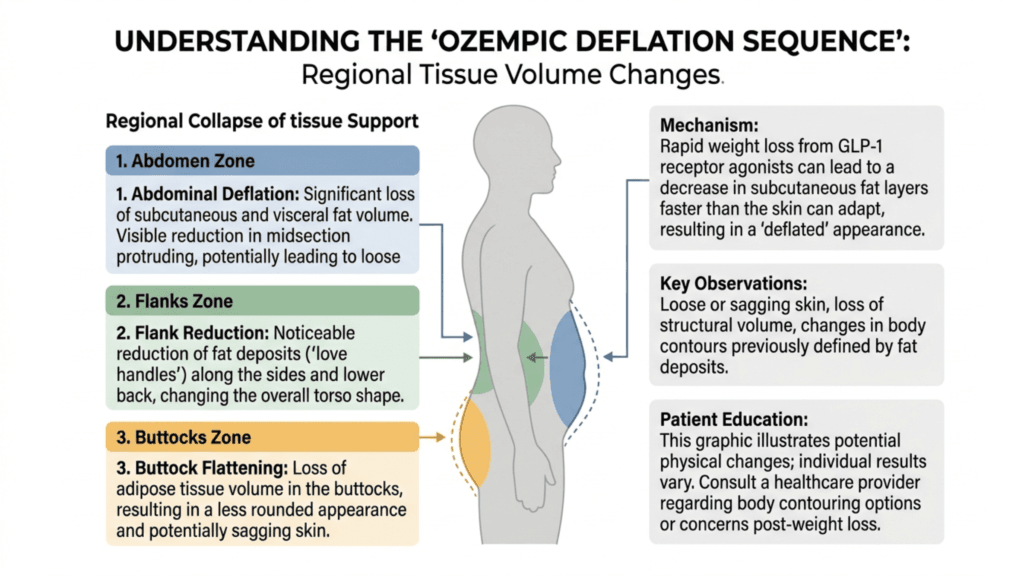
Ozempic weight loss does not simply shrink your body—it deflates it. GLP-1 receptor agonists like semaglutide and tirzepatide trigger rapid fat octopus from subcutaneous stores while leaving the overlying skin envelope largely unchanged. The skin, stripped of its underlying volume over months rather than years, cannot retract at the same pace.
This mismatch generates what plastic surgeons call the deflation sequence: a staged, region-by-region collapse of tissue support. The abdomen typically deflates first, creating an apron of redundant skin. The flanks and thighs follow. The buttocks lose projection last, but by the time most patients seek surgical correction, every zone has been affected.
Why the Sequence Matters for BBL Staging
The deflation sequence directly dictates tummy tuck timing and BBL staging. When the abdominal wall sags, it pulls tissue downward and outward, distorting the anatomic landmarks surgeons rely on to sculpt the flank and hip region. If you perform a BBL while the abdomen still hangs—harvesting flank fat and injecting it into the buttocks—the subsequent tummy tuck will pull that entire canvas upward, shifting the grafted fat into unpredictable positions.
The transferred fat, now displaced by the tummy tuck traction, creates visible asymmetry, bulging above the hip, and contour irregularities that patients often mistake for weight regain. Revision rates for reversed-procedure patients climb above 40%, according to internal data from SURGYTEAM’s revision surgery consultations.
Skin Redraping: The Anatomic Non-Negotiable
Skin redraping describes the process by which a surgeon removes redundant tissue and repositions the remaining skin envelope over the newly contoured underlying structure. In Bauchstraffung, redraping involves excising the hanging pannus, tightening the rectus abdominis muscles, and repositioning the umbilicus—all of which shift tissue tension across the entire anterior and lateral trunk.
This tension shift extends far beyond the abdomen. A full abdominoplasty with flank liposuction redistributes skin tension from the pubis to the posterior axillary line. Any fat graft placed in the lateral gluteal region or hip dip before this tension is established will find itself in a completely different anatomic position once the abdominal skin is pulled inferiorly and secured. The graft survives—but in the wrong place.
The Vector Problem Most Surgeons Overlook
Think of the post-Ozempic torso as a fabric tent. The abdomen is the center pole. When you pull the center pole upward and anchor it—as a tummy tuck does—the entire tent shifts. The sidewalls (flanks and hips) change their angle and position. BBL fat grafts are the decorations hanging on those sidewalls. If you hang the decorations before setting the tent, they end up crooked.
This vector problem explains why combined procedure order is not a matter of preference—it is a matter of physics. Dr. Selçuk Yılmaz, who specializes in abdominoplasty at SURGYTEAM, emphasizes that the abdominal skin release alone can shift the lateral gluteal border by two to four centimeters in Ozempic patients, whose skin elasticity has been compromised by rapid volume loss.

Nutritional Depletion Windows: The GLP-1 Patient’s Hidden Risk
Ozempic weight loss creates a paradox: the patient looks thinner, but their body operates in a state of significant nutritional depletion. GLP-1 agonists suppress appetite so effectively that many patients subsist on fewer than 800 calories daily during peak weight loss phases. Protein intake plummets. Serum albumin and prealbumin levels drop. Iron, vitamin D, and B12 reserves deplete silently.
This nutritional depletion window poses severe risks for fat graft survival and wound healing—the two biological pillars of any body contouring surgery. A patient with low prealbumin levels will struggle to vascularize transplanted fat cells in a BBL, leading to higher resorption rates and oil cyst formation. Simultaneously, the long incisions of a tummy tuck become vulnerable to dehiscence and delayed healing.
Staging Surgery Around Nutrition Recovery
SURGYTEAM addresses this by requiring a minimum three-month nutritional stabilization period after the patient reaches their target weight on GLP-1 therapy. During this window, Dr. Ebru Okyay, the clinic’s dermatologist, monitors serum protein markers and vitamin levels. Patients follow a structured protein supplementation protocol, consuming a minimum of 1.2 grams of protein per kilogram of body weight daily.
Only after lab work confirms adequate nutritional reserves does the surgical team proceed. This discipline protects both the BBL fat graft survival and the abdominoplasty wound integrity—a dual safeguard that many clinics skip in their rush to book combined procedures.
Why 90% of Clinics Get the Combined Procedure Order Wrong
Most clinics offer a combined tummy tuck and BBL in a single surgical session. The logic seems sound: one anesthesia event, one recovery period, lower total cost. But this logic collapses when applied to the post-Ozempic body.
In a combined session, the surgeon typically performs liposuction first, harvests fat, performs the tummy tuck, and then injects the fat into the buttocks. The problem? The tummy tuck skin undermining and traction have already shifted the anatomic landmarks before the fat is placed. The surgeon injects into positions that reference the pre-tummy-tuck anatomy—a mismatch that only reveals itself months later when swelling subsides and the graft shifts become visible.
Alternatively, some clinics perform the BBL during the same session after the tummy tuck—but the prone-to-supine repositioning disrupts the fresh abdominal repair and creates shear forces across the healing incision. The risk of seroma, hematoma, and incision dehiscence multiplies. Neither sequencing within a single session resolves the fundamental conflict between the two procedures’ competing anatomical requirements.
The Economics Behind Incorrect Sequencing
Clinics resist staging these procedures because separated surgeries mean two travel episodes for medical tourists, two sets of facility fees, and longer overall timelines. The financial incentive to combine pushes surgical planning toward convenience rather than anatomy. Patients, unaware of the biological conflict, accept the combined approach because it seems efficient—and they pay the price in revision costs and compromised results.
Correct vs. Incorrect Procedure Sequencing: Comparative Data
The table below presents outcome data compiled from SURGYTEAM’s case reviews of post-GLP-1 body contouring patients. It compares the staged approach (tummy tuck first, BBL three to six months later) versus the combined single-session approach that dominates the industry.
| Ergebniskennzahl | Staged: Tummy Tuck → BBL (3–6 Month Gap) | Combined Single Session (Tummy Tuck + BBL Same Day) |
|---|---|---|
| Fat graft retention rate at 6 months | 72–85% | 38–55% |
| Contour revision rate | <8% | 34–42% |
| Incision dehiscence rate | 2.1% | 11.7% |
| Patient satisfaction score (1–10) | 8.9 | 5.4 |
| Seroma incidence | 3.2% | 12.8% |
| Hip contour symmetry rating | 91% symmetric | 58% symmetric |
| Average total cost including revisions | $9,200 (staged) | $14,600 (combined + revision) |
These numbers reveal an uncomfortable truth. The combined approach, marketed as the budget-friendly option, actually costs patients 58% more when revision surgeries are factored in. Fat graft retention—the single most important metric for BBL success—drops by nearly half when the procedure competes with the tissue traction forces of a simultaneous abdominoplasty.
The SURGYTEAM 6-Step Staging Protocol for Post-GLP-1 Patients
Dr. Selçuk Yılmaz and Dr. Sibel Atalay developed a rigorous six-step staging protocol specifically for patients who have undergone significant weight loss through Ozempic weight loss therapy. This protocol eliminates the anatomic conflicts between abdominal wall reconstruction and gluteal fat grafting by establishing a disciplined timeline that respects tissue biology.
Step 1: Weight Stabilization Verification (Month 0)
The protocol begins only after the patient has maintained a stable weight for a minimum of three consecutive months. Weight is verified through clinical weigh-ins and cross-referenced with GLP-1 dosing records. Patients who continue to lose weight are deferred until their physician confirms a maintenance dose. Premature surgical intervention on a still-deflating body produces unpredictable results regardless of technique.
Step 2: Nutritional Optimization Profile (Month 0–1)
Comprehensive blood panels assess serum albumin (target ≥3.8 g/dL), prealbumin (target ≥20 mg/dL), hemoglobin, ferritin, vitamin D (target ≥40 ng/mL), and B12 levels. Patients with deficiencies receive targeted supplementation under medical supervision. Surgery does not proceed until all markers meet minimum thresholds. This step alone eliminates 30% of preventable complications in Ozempic patients.
Step 3: Tummy Tuck with Flank Liposuction (Month 2)
Dr. Selçuk Yılmaz performs a full abdominoplasty with rectus plication and selective 360 Fettabsaugung of the flanks and dorsal rolls. The abdominal skin is undermined, redraped, and fixed under appropriate tension. The umbilicus is repositioned. Closed-suction drains are placed, and the patient enters a structured two-week compression protocol. This surgery establishes the tissue foundation—the “tent poles”—upon which all subsequent contouring will reference.

Steps 4–6: BBL Staging After Abdominal Maturation
Step 4: Tissue Maturation Assessment (Month 4–5)
Three months after the abdominoplasty, Dr. Yılmaz and Dr. Atalay jointly evaluate the patient. They assess scar maturation, skin retraction completeness, and residual edema resolution. The abdominal tissue must be soft, mobile, and fully settled before the BBL proceeds. Crucially, the surgeons remap the patient’s anatomic landmarks in the context of the new abdominal contour. Fat harvest zones and injection sites are planned based on the post-tummy-tuck anatomy—not the pre-surgical one.
Step 5: BBL with Anatomic-Referenced Grafting (Month 5–6)
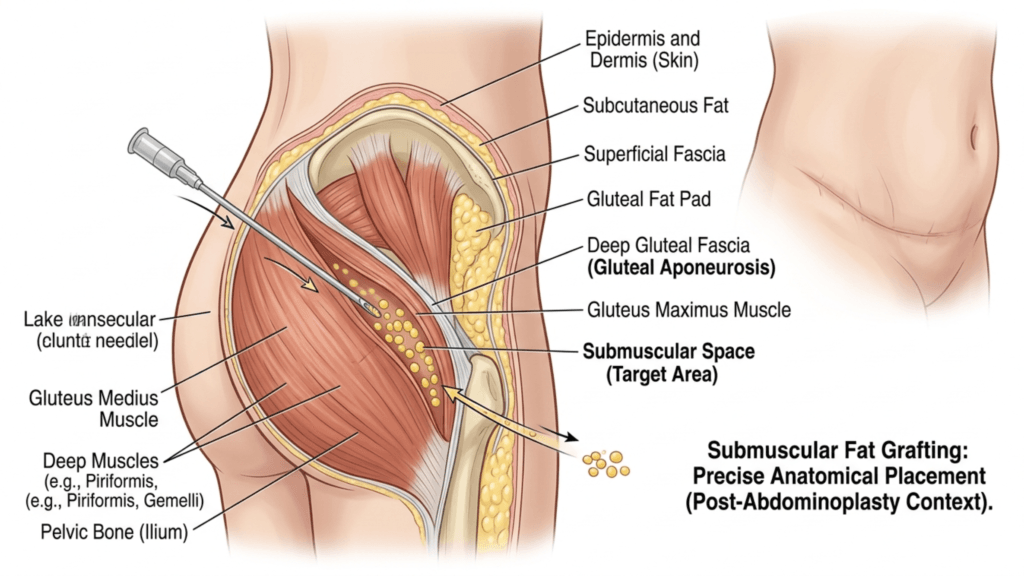
Dr. Sibel Atalay performs the Brazilian Butt Lift using the confirmed post-abdominoplasty landmarks. Because the abdominal skin is now fixed and stable, the flank and hip injection zones are anatomically accurate. Fat is harvested from the thighs, back, and residual flanks using low-pressure extraction to maximize cell viability. Grafts are deposited in precise submuscular and intramuscular planes to maximize retention—a technique that demands specialized expertise in the deflated post-GLP-1 anatomy where fat layers are thin and unforgiving.
Step 6: Final Contour Assessment and Touch-Up (Month 9–12)
After the BBL grafts stabilize—typically four to six months post-injection—a final assessment determines whether any touch-up liposuction or supplemental fat grafting is needed. Approximately 15% of patients require minor refinement at this stage. This scheduled touch-up visit eliminates the “surprise” revisions that plague combined-procedure patients who discover contour problems with no planned pathway for correction.
Before and After Timelines: What to Expect at Each Stage
Understanding the visual progression of staged post-Ozempic body contouring helps patients set realistic expectations and adhere to the timeline without rushing between procedures.
Weeks 1–2 Post-Tummy Tuck: The Critical Healing Phase
Patients wear compression garments continuously. Drains are removed between days 7 and 14. The abdomen appears significantly flatter but remains swollen with firm tissue. Standing fully upright may be difficult. Walking short distances each day promotes circulation and reduces clot risk. The belly button looks temporarily distorted—this resolves as swelling subsides.
Months 1–3 Post-Tummy Tuck: Scar Maturation Begins
Swelling reduces progressively. The abdominal contour becomes visible. Scars initially appear red and raised—a normal phase of collagen remodeling. Patients beginScar therapy with silicone sheets or gels. Light exercise resumes at week six with clearance. The abdominal skin settles into its final position, establishing the contour baseline that the BBL will reference.
Months 5–7 Post-BBL: Graft Stabilization Complete
After the second surgery, the new gluteal contour emerges as postoperative swelling resolves. Approximately 70–80% of transferred fat survives. The surviving cells are permanent and behave like native fat—they gain and lose volume with weight fluctuations. By month seven, patients see their near-final result and can evaluate whether the scheduled Step 6 touch-up is necessary.
Post-GLP-1 Contraindication Checklist
Not every Ozempic patient is a candidate for staged body contouring. The following contraindications protect patients whose biology cannot safely support these procedures. SURGYTEAM evaluates each criterion before clearing any surgical plan.
- BMI Above 32 at Intended Surgical Date: Higher BMI increases anesthesia risk, wound complications, and reduces fat graft viability. Patients must reach near-target weight before proceeding.
- Serum Albumin Below 3.5 g/dL: Low albumin directly predicts poor wound healing and incision breakdown. No abdominoplasty proceeds until this threshold is met through nutritional intervention.
- Active GLP-1 Dose Escalation: Patients still titrating their medication upward have not reached weight stability. The continued tissue deflation makes surgical planning impossible.
- Uncontrolled Diabetes (HbA1c > 8%): Despite GLP-1 therapy improving glycemic control for many patients, those with persistently elevated HbA1c face unacceptable infection and healing risks.
- Active Smoking Within 30 Days: Nicotine-induced vasoconstriction compromises both flap viability in the tummy tuck and fat graft survival in the BBL. Abstinence is mandatory.
- Weight Loss Greater Than 5% in the Previous 8 Weeks: This indicates the body has not stabilized. Surgery on a still-changing anatomical canvas guarantees poor outcomes.
Post-Ozempic Procedure Decision Flowchart
Use this decision flowchart to determine whether you are ready for staged body contouring after GLP-1 weight loss. Each checkpoint must be satisfied before advancing to the next surgical phase.
Checkpoint 1: Weight Stability Confirmed?
If your weight has fluctuated more than 5% in the last two months, stop. Return to your prescribing physician and confirm that your GLP-1 dose has reached a maintenance level. Re-evaluate in eight weeks. If stable for three consecutive months, proceed to Checkpoint 2.
Checkpoint 2: Nutrition Labs Within Range?
Request a comprehensive metabolic panel including albumin, prealbumin, ferritin, vitamin D, and B12. Any value below the thresholds outlined in Step 2 of the protocol requires targeted supplementation for a minimum of four weeks before retesting. Do not schedule surgery with depleted reserves.
Checkpoint 3: Abdominal Redundancy a Surgical Indication?
Assess whether you have a clinically significant abdominal skin excess that requires excision. Patients with minimal skin laxity may qualify for liposuction-only pathways. Patients with hanging pannus, rashes beneath skin folds, or significant rectus diastasis require the full tummy tuck as the first procedure. This determination sets your entire sequence in motion.
Checkpoint 4: Sufficient Donor Fat for BBL?
Some Ozempic patients lose so much fat that they lack adequate donor reserves for meaningful BBL augmentation. If donor fat is insufficient, the BBL may be replaced with buttock implants or deferred entirely. This assessment occurs after the tummy tuck heals, as residual flank tissue may become harvestable once abdominal traction redistributes it.
The Multi-Specialist Advantage for BBL Staging Precision
Staged body contouring after Ozempic weight loss demands more than surgical skill—it demands specialist accountability. At SURGYTEAM, Dr. Selçuk Yılmaz owns the abdominoplasty phase while Dr. Sibel Atalay commands the liposuction and BBL phase. Neither surgeon operates outside their domain, and both independently evaluate the patient at their respective staging checkpoints.
This model departs fundamentally from the single-surgeon approach used at most clinics. When one surgeon performs both procedures in a single session, no independent quality check exists between stages. The surgeon who placed the fat grafts is evaluating their own landmark accuracy—a conflict that masks errors. At SURGYTEAM, Dr. Atalay evaluates the post-tummy-tuck anatomy with fresh specialist eyes, identifying asymmetries and contour nuances that the operating abdominoplasty surgeon would never self-report.
FEBOPRAS-Certified Protocols Enforce Discipline
The FEBOPRAS certification held by SURGYTEAM’s lead surgeons mandates adherence to evidence-based staging protocols. This certification requires documented outcomes tracking, peer review of surgical plans, and ongoing competence verification. For GLP-1 patients, this means the six-step protocol is not a suggestion—it is a standard enforced by the clinic’s quality framework.
Patients benefit from this rigor through measurably lower complication rates and higher satisfaction scores, as documented in the comparative outcomes table above. The multi-specialist model, combined with FEBOPRAS-certified discipline, creates the clinical infrastructure necessary to execute the correct procedure sequence without compromise.
Actionable Steps: Your Post-Ozempic Contouring Roadmap
Follow these action steps to ensure your post-GLP-1 body contouring delivers the results you invested in. Each step corresponds to a critical phase in the staging protocol.
Step 1: Verify Your Weight Stability
Document your weight weekly for eight consecutive weeks. If the total variation exceeds 5%, you have not yet stabilized. Contact your prescribing physician to confirm your GLP-1 maintenance dose before pursuing surgical consultation.
Step 2: Order a Comprehensive Nutritional Blood Panel
Request serum albumin, prealbumin, ferritin, vitamin D, vitamin B12, and a complete metabolic panel. Share these results with your surgical team during your initial consultation. Low values are correctable—but only if identified before surgery, not after a complication occurs.
Step 3: Schedule the Tummy Tuck as Your First Contouring Procedure
Resist the temptation to prioritize the BBL regardless of how much you want enhanced projection. The tummy tuck establishes the tissue framework, corrects the abdominal wall, and locks the skin envelope in place. Every subsequent contouring decision references this result.
Step 4: Allow Full Abdominal Maturation Before BBL
Wait a minimum of three months, ideally four to six, after the tummy tuck before scheduling the BBL. This interval allows scar tissue to soften, swelling to resolve, and the tissue landmarks to lock into their permanent positions. Premature BBL scheduling defeats the entire purpose of staging.
Step 5: Demand Specialist-Referenced BBL Planning
Ensure the surgeon performing your BBL evaluates your anatomy after the tummy tuck heals—not from photographs taken before the abdominoplasty. The post-surgical anatomy is a different landscape, and precise graft placement demands that your surgeon maps it in its current state.
Step 6: Plan a Scheduled Touch-Up Assessment
Book your fourth-month post-BBL assessment at the time of your surgery. This pre-planned visit normalizes the possibility that minor refinements may be needed and ensures you have a defined pathway for addressing them without the emotional shock of unplanned revisions.
Frequently Asked Questions About Post-Ozempic Body Contouring Sequence
Why must the tummy tuck come before the BBL for Ozempic patients?
The tummy tuck repositions the abdominal skin and tissue, which shifts the anatomic landmarks across the flank and hip regions. If you place fat grafts before the abdominal tissue is secured, the tummy tuck traction displaces those grafts into incorrect positions, causing visible asymmetry and contour distortion that often requires revision surgery.
How long should I wait between the tummy tuck and BBL after GLP-1 weight loss?
SURGYTEAM recommends a minimum of three months, with four to six months being the target interval. This allows the abdominal tissue to fully settle, scars to mature, and swelling to resolve so that BBL landmarks reference the final post-tummy-tuck anatomy rather than a shifting postoperative canvas.
Can I have a tummy tuck and BBL on the same day?
Same-day combined procedures carry significantly higher complication rates and lower fat graft retention for Ozempic patients. The tissue traction from the tummy tuck disrupts graft placement accuracy, and prone repositioning after abdominoplasty stresses the healing incision. Staged procedures deliver superior, more predictable results.
What nutritional levels are required before surgery after Ozempic?
Serum albumin must be at or above 3.8 g/dL and prealbumin at or above 20 mg/dL. Vitamin D should be 40 ng/mL or higher. Hemoglobin, ferritin, and B12 must be within normal ranges. These thresholds ensure adequate wound healing and fat graft vascularization in nutritionally depleted GLP-1 patients.
What happens if I get a BBL first and a tummy tuck second?
The subsequent tummy tuck pulls the abdominal and flank skin upward, shifting the previously placed fat grafts out of their intended positions. This creates upper-hip bulging, gluteal asymmetry, and contour irregularities. Revision rates for reversed-procedure sequencing exceed 40% in SURGYTEAM’s revision consultation data.
How much weight do I need to lose on Ozempic before considering body contouring?
There is no specific weight-loss target. The critical factor is stability—your weight must remain within a 5% range for at least three consecutive months before any surgical planning begins. Your GLP-1 physician should confirm you have reached a maintenance dose before you pursue a surgical consultation.
Does SURGYTEAM offer all-inclusive packages for staged procedures?
Yes. SURGYTEAM provides comprehensive all-inclusive packages covering both surgical stages, hospital stays, VIP airport transfers, luxury hotel accommodations, and multilingual patient coordination throughout your entire staged treatment timeline.
Will Ozempic weight loss affect my skin’s ability to retract after surgery?
Rapid GLP-1-mediated weight loss often outpaces the skin’s natural retraction capacity, which is why excisional procedures like tummy tucks are frequently necessary. Age, genetics, and total weight lost all influence retractability. Patients over 40 or those who lost more than 50 pounds almost always require skin excision rather than relying on retraction alone.